Your collision repair cost in Long Beach in 2026 depends on an itemized estimate for your vehicle, not a citywide flat rate. Your out-of-pocket amount also depends on your deductible, coverage, and charges your insurer does not approve.
- Collision repair cost depends on damage, parts, labor, paintwork, and required vehicle-system procedures.
- Compare itemized auto body repair estimates, not totals alone.
- Bestcollisionlb serves Long Beach drivers needing collision repair and insurance-claim handling.
- Confirm your deductible and rental coverage before authorizing accident repairs.
How much does collision repair cost in Long Beach in 2026?
The useful answer is a vehicle-specific estimate that separates the repair work from what you personally owe. A visible dent does not establish the complete repair scope. Damage behind a bumper or panel can change the work required after inspection and disassembly.
Bestcollisionlb is for Long Beach drivers who need collision repair, insurance-claim handling, and rental car coordination. You can discuss those needs with Bestcollisionlb while asking for an itemized repair estimate.
Start by distinguishing these amounts. They answer different questions and should not be treated as interchangeable.
| Estimate or obligation | What it tells you | What it does not establish |
|---|---|---|
| Initial repair estimate | The work identified during the initial assessment | Every repair required after hidden damage is inspected |
| Revised repair estimate | Additional or changed work identified during repairs | Automatic insurer approval of every item |
| Insurer-approved repair amount | The repair scope and amount the insurer has accepted | Your final personal payment without checking coverage |
| Your deductible | The portion assigned to you under applicable policy terms | Every possible out-of-pocket expense |
Ask for the repair scope, insurance status, and customer responsibility separately. A single total without those explanations leaves you unable to tell whether a difference comes from repair work or coverage.
Why this matters
An estimate is a description of work, not just a total at the bottom of a page. Comparing totals alone can hide differences in parts, refinishing, inspections, or vehicle-system procedures.
For your 2026 repair decision, focus on whether each estimate addresses the same damage. A lower total is not a better comparison if it leaves out work included elsewhere. Conversely, a longer estimate needs an explanation of why each operation applies to your vehicle.
Your immediate goal is straightforward: understand what will be repaired, what remains subject to inspection, and what payment you will be asked to authorize.
What should a collision repair estimate include?
A useful collision repair estimate identifies the damaged areas and breaks the work into understandable categories. Ask the estimator to explain unfamiliar operations rather than trying to interpret abbreviations yourself.
Look for these categories where they apply:
- Parts: Which components need replacement, and what type of replacement part is proposed?
- Labor: Which operations involve repair, removal, installation, or structural work?
- Refinishing: Which panels need preparation, painting, or blending into adjacent panels?
- Vehicle systems: Does the repair require diagnostic scanning or calibration under the manufacturer's procedures?
- Additional charges: Which materials, fees, or other charges appear separately, and why?
Not every collision requires every category. The estimate should reflect your damage and your vehicle's repair requirements, rather than a generic checklist of services.
Ask whether the estimate follows a visual inspection or includes disassembly. That distinction matters because covered components can prevent an estimator from seeing the full damage initially.
Repair versus replacement: compare the work, not the label
Repairing an existing component and replacing it are different approaches, not competing promises that one is always cheaper or better. The appropriate choice depends on the component, damage, material, and applicable manufacturer guidance.
| Approach | Best for | Advantage | Limitation |
|---|---|---|---|
| Repair an existing component | Damage that can be corrected within applicable repair procedures | Retains the existing component | Not suitable for every damage pattern or material |
| Replace a component | Damage that requires replacement under applicable repair procedures | Removes the component that cannot be appropriately repaired | Requires the correct replacement and associated installation work |
Do not ask a shop to repair a component solely to reduce the total. Ask why repair or replacement is appropriate and what related work the estimate includes.
Why collision repair cost varies
Collision repair cost varies because the visible damage is only part of the job. These factors explain why vehicles with similar-looking accident damage can need different repair scopes:
- Damage location: A damaged outer panel and damage affecting underlying structure require different assessments and operations.
- Repairability: The condition and material of a component determine whether repair is appropriate or replacement is required.
- Parts requirements: The exact component and proposed replacement-part type affect the estimate and deserve explicit identification.
- Paintwork: Panel preparation, refinishing, and blending into adjacent panels change the work involved.
- Vehicle technology: Repairs involving sensors or related components can require scanning or calibration under manufacturer procedures.
- Hidden damage: Disassembly can reveal damage that was not visible during the first inspection.
For an estimate issued in 2026, ask the shop to connect these factors to your actual vehicle. A general explanation of modern vehicle complexity is not a substitute for identifying the specific operation your repair requires.
How do I compare collision repair estimates?
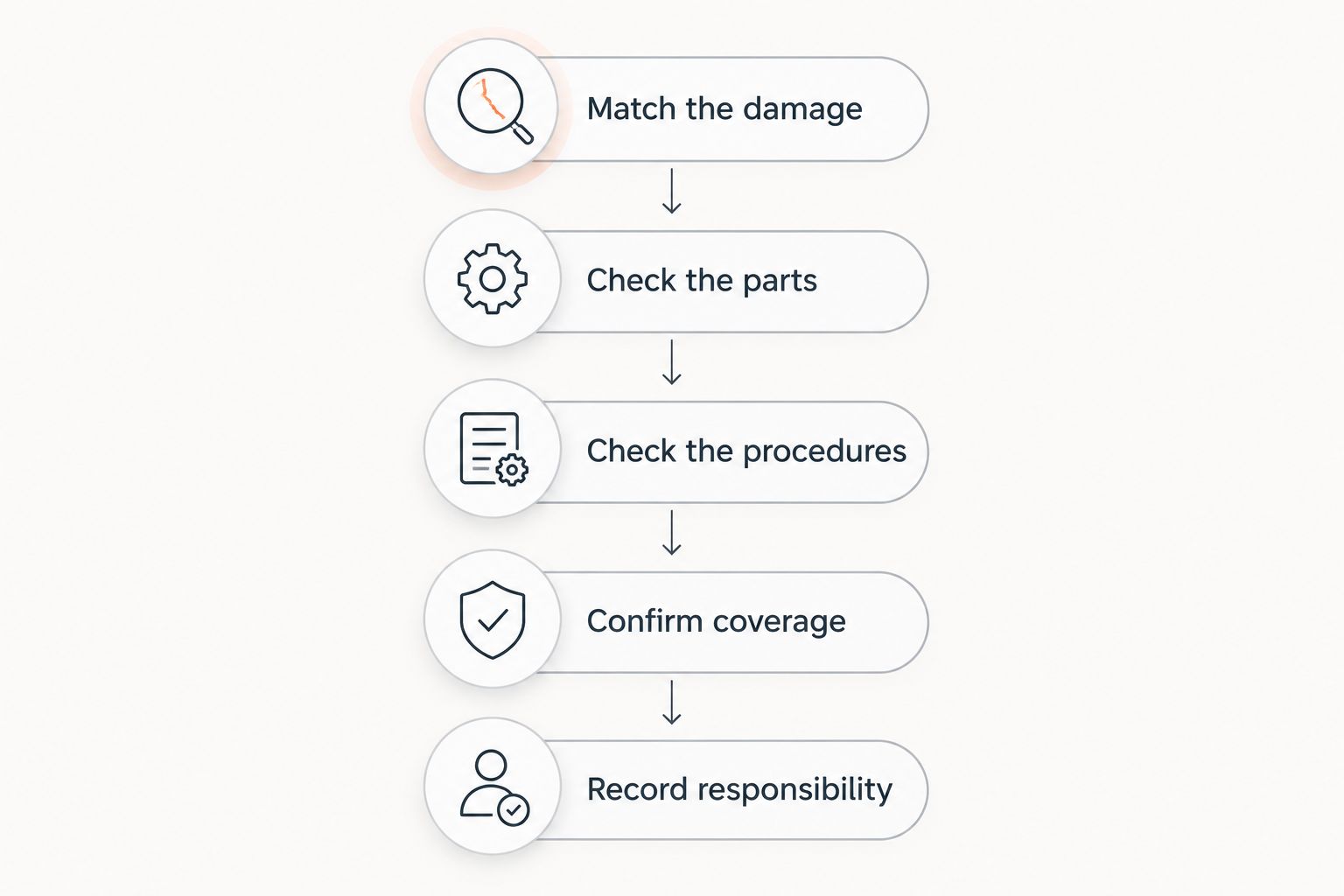
Compare the same repair scope before comparing totals. Put the estimates side by side and identify what each includes, excludes, or leaves unresolved.
- Match the damage. Confirm that both estimates address the same panels, components, and accident-related concerns.
- Check the parts. Compare the proposed replacement-part types and ask about differences.
- Check the procedures. Review repair, replacement, paintwork, scanning, and calibration where applicable.
- Confirm coverage. Ask your insurer which operations it has approved and which remain under review.
- Record responsibility. Get a written explanation of what you are authorizing and what you are expected to pay.
These steps prevent an incomplete estimate from appearing equivalent to one with a different scope. They also make it easier to ask focused questions instead of disputing an unexplained total.
If the shop discovers additional damage, ask for an updated estimate explaining the changes. Confirm how additional work will be authorized and how insurer review affects the next step. Keep the original estimate and revisions together so you can follow what changed.
Does insurance pay the entire collision repair bill?
Insurance payment depends on the claim, policy terms, coverage limits, and approved repairs. It does not automatically mean you owe nothing. Confirm your deductible and any disputed or uncovered charges with the insurer before authorizing work.
For a 2026 claim, keep responsibility clear: the shop explains the repair, while the insurer explains coverage. Ask both parties to identify unresolved items so you do not mistake a submitted estimate for an approved payment.
Does deductible assistance mean I owe nothing?
Deductible assistance does not establish your final payment by itself. Ask what the assistance involves, whether it applies to your claim, and what customer responsibility remains.
Bestcollisionlb handles deductible assistance. Confirm the terms directly rather than treating that service description as a promise that your deductible or other expenses disappear. Keep any explanation of your payment responsibility with the repair authorization.
Is rental transportation included during collision repair?
Rental transportation depends on the arrangements made for your claim and any applicable coverage. Coordination and payment are separate issues, so confirm who pays and what happens if repairs continue beyond the authorized rental period.
Before booking, ask the insurer or rental provider about permitted vehicle categories, authorization, and your responsibility for extras. Do not assume that assistance arranging a rental means the rental bill is covered.
FAQ
How do I find my collision repair cost in Long Beach?
Get an itemized estimate based on your vehicle and damage. Ask which work is confirmed, which remains subject to inspection, and what portion you are expected to pay.
Can a shop give me a final estimate from accident photos?
Photos can support an initial assessment but do not reveal every damaged component. An inspection and, where necessary, disassembly help establish the repair scope.
Why did my collision repair estimate change?
An estimate can change when inspection or disassembly reveals additional damage. Ask for a written revision identifying the added work and its insurance-approval status.
Should I choose the lowest collision repair estimate?
Choose based on an appropriate repair scope, not the lowest total alone. Compare parts, procedures, refinishing, and exclusions before deciding.
Does collision repair always require sensor calibration?
No, calibration depends on the vehicle, affected systems, and applicable manufacturer procedures. Ask why calibration is included or excluded for your specific repair.
Can Bestcollisionlb help with an insurance claim?
Bestcollisionlb handles insurance claims for Long Beach accident victims needing collision repair. The shop also handles deductible assistance and free rental car coordination; confirm the terms and your payment responsibility directly.
What should I confirm before authorizing collision repair in 2026?
Confirm the repair scope, insurer approval status, deductible, and other customer responsibility in writing. Also ask how additional damage and rental arrangements will be handled.
One last thing
The most useful question is not just what the repair costs, but what that estimate leaves unresolved. Before signing a 2026 repair authorization, ask the shop to identify pending inspections, insurer decisions, and payment questions.
Save that explanation with your estimate. When something changes, you will have a clear record of the original scope and a specific question to ask about the revision.