
No. California drivers do not have to use their insurer’s recommended body shop; you can choose where your car is repaired. Choosing your own shop does not automatically settle what insurance will pay, so confirm the repair scope, coverage, and any out-of-pocket responsibility before authorizing work.
- An insurance approved body shop is an option, not a California requirement.
- Choose collision repair based on a written repair plan, clear communication, and documented insurance claim handling.
- Bestcollisionlb handles Long Beach collision repair and insurance claims; deductible assistance and free rental coordination depend on eligibility.
- Get disputed repair items explained before authorizing work, rather than assuming every charge is covered.
Do you have to use your insurer’s recommended body shop?
You choose the repair shop. Your insurer determines coverage under the policy and applicable law. Those are separate decisions, and confusing them can leave you unsure who is responsible for the bill.
California Insurance Code section 758.5 prohibits an insurer from requiring repairs at a particular automotive repair dealer. For a Long Beach claim in 2026, an insurer’s recommendation does not replace your right to choose.
An insurance approved body shop usually means a shop participating in an insurer’s repair program. It is not a separate California repair license, and the phrase alone does not establish a shop’s certifications or suitability for your vehicle.
| Repair-shop option | Best for | What to verify | Main caution |
|---|---|---|---|
| Insurer-recommended shop | Drivers who want to consider the insurer’s referral | Repair scope, authorization process, and written warranty terms | A referral does not replace your review of the estimate |
| Your chosen shop | Drivers who prefer a particular repairer or want another assessment | Claim communication, disputed repair items, and your payment responsibility | Shop choice does not automatically resolve coverage disagreements |
Bestcollisionlb handles collision repair and insurance claims in Long Beach. You can ask for an estimate or claim review without assuming that choosing the shop guarantees insurance approval.
Why this matters
After an accident, a referral can sound like an instruction. You might hear that the recommended shop makes the claim easier, then worry that choosing somewhere else will cancel your coverage.
A recommendation is not a requirement. Ask the adjuster to distinguish between a preferred repair location and an actual policy condition.
For Long Beach drivers comparing shops in 2026, the useful question is not just whether a shop is on a list. It is whether you understand the repair plan, who will document additional damage, and what you are authorizing.
A clear answer protects your choice without turning an ordinary claim discussion into an argument. Keep the conversation focused on the vehicle and the written estimate.
What does an insurance approved body shop actually mean?
Insurers use different names for their repair arrangements, including preferred shops and direct repair programs. Ask what the arrangement means for your specific claim rather than treating the label as a guarantee.
A participating shop can be a reasonable choice. The insurer’s recommendation alone, however, does not tell you which repair procedures the estimate includes, what parts are proposed, or how a disagreement will be handled.
A shop outside that program is not automatically unsuitable for an insurance claim. Ask whether the shop communicates with adjusters and what documentation it provides when the initial estimate does not cover the repair plan.
Do not infer insurer-network membership from a shop’s statement that it handles insurance claims. Those are different claims. Ask directly if network participation matters to your decision.
How do you choose a shop without losing control of the claim?
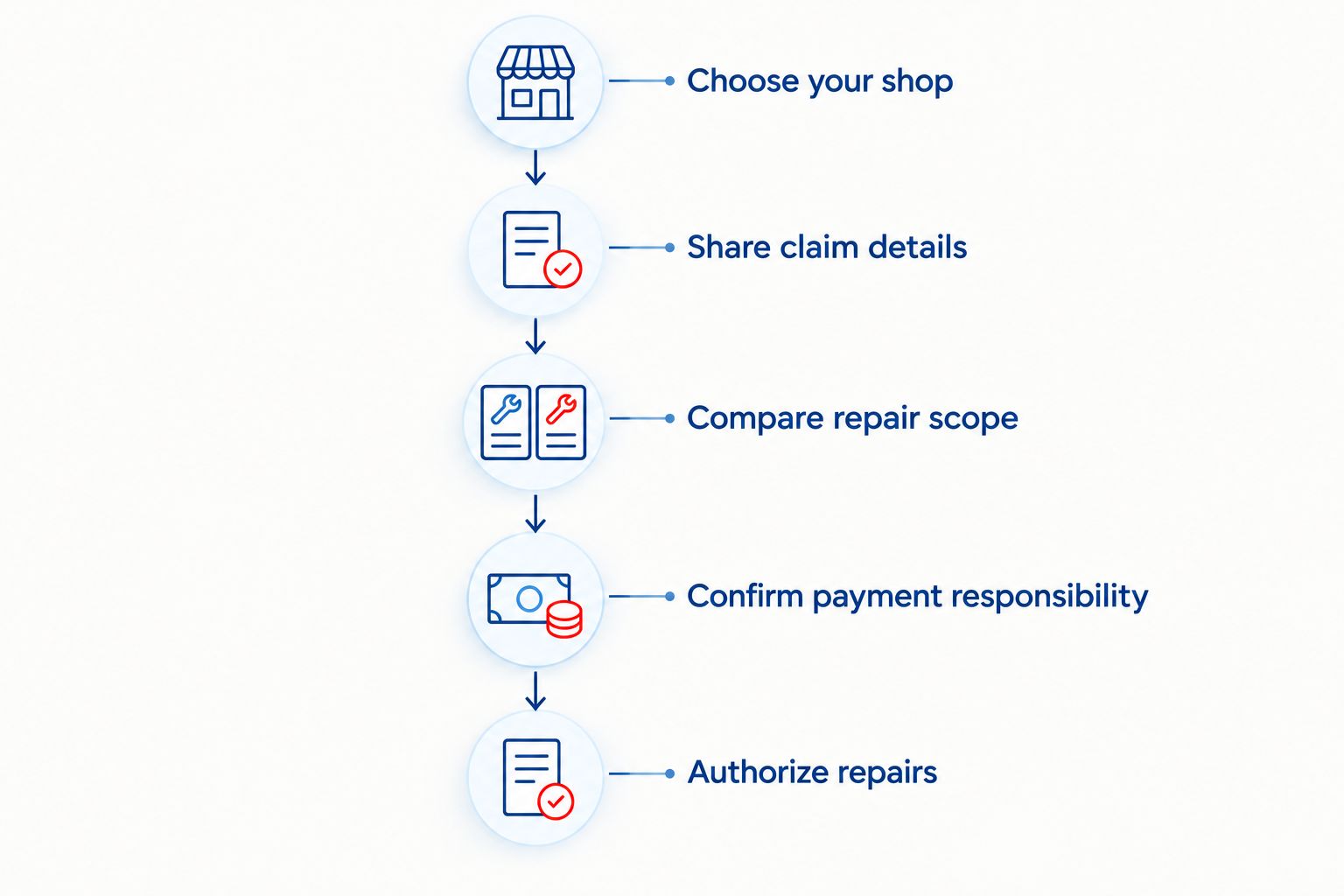
Follow this sequence before signing a repair authorization. It separates choosing a shop from agreeing to the work and payment terms.
- Choose your shop. Tell the insurer where you want the vehicle inspected or repaired. If you are still comparing shops, say so rather than authorizing repairs before you have decided.
- Share claim details. Give the shop the claim number, adjuster’s contact information, insurer’s estimate, and any relevant damage photos. Ask who will handle communication about repair differences.
- Compare repair scope. Check whether the estimates describe the same damage, parts, labor operations, and related procedures. A different total does not explain the disagreement by itself.
- Confirm payment responsibility. Ask what insurance has accepted, what remains under review, and what you would owe under the proposed authorization. Request an explanation of any unresolved charges.
- Authorize repairs. Read the authorization and ask how additional work will be presented for your approval. Keep copies of the estimate, authorization, and claim correspondence.
The sequence matters because an insurer’s estimate and your repair authorization serve different purposes. Reviewing both helps you understand what the insurer has assessed and what you have asked the shop to do.
Why does the claim experience vary between shops?
The name on an insurer’s list does not answer every practical question. These differences deserve attention when you compare collision repair in Long Beach:
- Estimate detail: A useful estimate identifies the proposed work instead of leaving you with only a total.
- Claim communication: Ask who sends supporting documentation and who updates you when the adjuster responds.
- Additional damage: Ask how the shop documents damage discovered after parts are removed.
- Authorization terms: Read how the shop requests approval for changes and explains your payment responsibility.
- Transportation arrangements: Confirm rental coverage and any separate assistance before relying on a vehicle during repairs.
- Repair documentation: Ask what final paperwork explains the completed work and any applicable warranty terms.
Use the same questions with a recommended shop and a shop you found yourself. Neither deserves an automatic pass.
Bestcollisionlb is a fit for Long Beach drivers seeking collision repair with insurance claim handling. Deductible assistance and free rental car coordination require an eligibility review; they are not automatic benefits for every customer.
What if the insurer says it will pay only its estimate?
Ask which repair items are disputed and why. A disagreement about a part, labor operation, or repair procedure needs a specific explanation, not just competing totals.
Ask the shop to identify the difference in writing. Supporting information can include damage photos, inspection findings, and applicable repair procedures. The insurer can then respond to the actual issue rather than an unexplained increase.
If the disagreement concerns newly discovered damage, ask whether the shop has submitted a supplemental estimate. A supplement requests consideration of additional repair work; submitting one does not itself mean the insurer has approved it.
Before accepting responsibility for a difference, read what happens when the insurance estimate is lower than the body shop estimate. Ask which items remain unresolved and whether you are being asked to authorize customer-paid work.
Keep written records of the explanations. If a shop-choice dispute remains unresolved, the California Department of Insurance provides consumer information and a complaint process. A complaint is not a promise of a particular payment outcome.
Can your insurer refuse your chosen body shop?
California insurers cannot require you to use a particular repair shop. They can still evaluate whether claimed work is covered and whether the proposed repair charges are supported.
If an adjuster objects to your choice, ask whether the objection concerns the shop itself or a specific estimate item. Request the explanation in writing, including any policy provision the insurer relies on.
For a 2026 claim, keep shop selection separate from authorization and coverage discussions. That makes it easier to identify whether the problem is improper pressure, missing documentation, or an actual repair disagreement.
Will choosing your own shop increase your deductible?
Choosing your own shop does not, by itself, change the deductible stated in your policy. A deductible and a disputed repair charge are different things.
Ask for a clear explanation of each customer-paid item. Do not accept a single unexplained balance described as your deductible if it also includes work the insurer has not agreed to pay.
Deductible assistance is also separate from claim coverage. Ask what assistance you qualify for, how it works, and what responsibility remains before authorizing repairs.
Should you move your car to a different shop?
Do not authorize a transfer until you understand the current shop’s release requirements and any charges. Choosing a different repairer and moving a vehicle already being stored or worked on are separate decisions.
Ask what you have already authorized, whether work has started, and what is needed to release the car. Then confirm transportation arrangements with the receiving shop.
You do not need to move the car simply because a shop is outside the insurer’s program. First establish whether there is a genuine repair, communication, or authorization problem that a transfer would address.
What should you ask before signing an estimate?
Use these questions during your 2026 estimate review. You want clear answers, not a sales pitch.
- Does this estimate cover all currently identified accident damage?
- Which parts and repair operations are included?
- What has the insurer accepted, and what is still under review?
- Will you contact me before performing additional work?
- What charges would I be responsible for under this authorization?
- What written warranty applies to the completed repairs?
- Who will update me about the claim and the vehicle?
If you are considering self-pay work, say that early. Small dents, scrapes, and cosmetic repairs still deserve a clear estimate; you do not need an insurance claim to ask about body repair.
For transportation, distinguish policy rental coverage from shop-coordinated assistance. Ask about eligibility and any charges you would owe before accepting a rental arrangement.
FAQ
Do I have to use an insurance approved body shop in California?
No. California Insurance Code section 758.5 prohibits insurers from requiring repairs at a particular automotive repair dealer. Your shop choice does not automatically determine coverage or resolve disputed repair charges.
Can I choose my own body shop in Long Beach?
Yes, you can choose your own body shop in Long Beach. Tell the insurer your choice and confirm the repair scope and payment responsibility before authorizing work.
Is an insurer-recommended body shop better than another shop?
An insurer recommendation alone does not establish that a shop is better for your repair. Compare the written repair plan, communication process, authorization terms, and applicable warranty.
Will insurance pay every charge at the shop I choose?
Choosing your own shop does not guarantee payment of every proposed charge. Ask the insurer and shop to identify unresolved repair items before you accept responsibility for them.
Can a body shop help if the insurance estimate is too low?
A body shop can document differences between the insurer’s estimate and the proposed repair plan. Photos, inspection findings, and repair information support the discussion, but do not guarantee approval.
Will my deductible be waived if I choose a different shop?
Choosing a different shop does not automatically waive your deductible. Deductible assistance depends on eligibility, so request a review and confirm what you would still owe.
Can I request body repairs without filing an insurance claim?
Yes, you can request an estimate for self-pay body repairs, including smaller or cosmetic damage. Ask for a clear repair scope and payment terms before authorizing the work.
One last thing
The most useful question is not whether a shop is approved. It is what you are approving. Read the authorization, identify unresolved insurance items, and ask how changes will reach you before additional work begins.
Keep that distinction in mind when reviewing collision repair options in 2026. An insurer referral helps you find a shop to consider; it does not make the repair decision for you.
Related guides
- How to compare auto body shops in Long Beach
- How to read a body shop estimate line by line
- Who approves extra collision repairs after hidden damage is found?
If you are unsure what to authorize, ask Bestcollisionlb for a collision repair estimate or insurance claim review. Insurance and self-pay enquiries are welcome; call to review eligibility for deductible assistance and free rental car coordination.