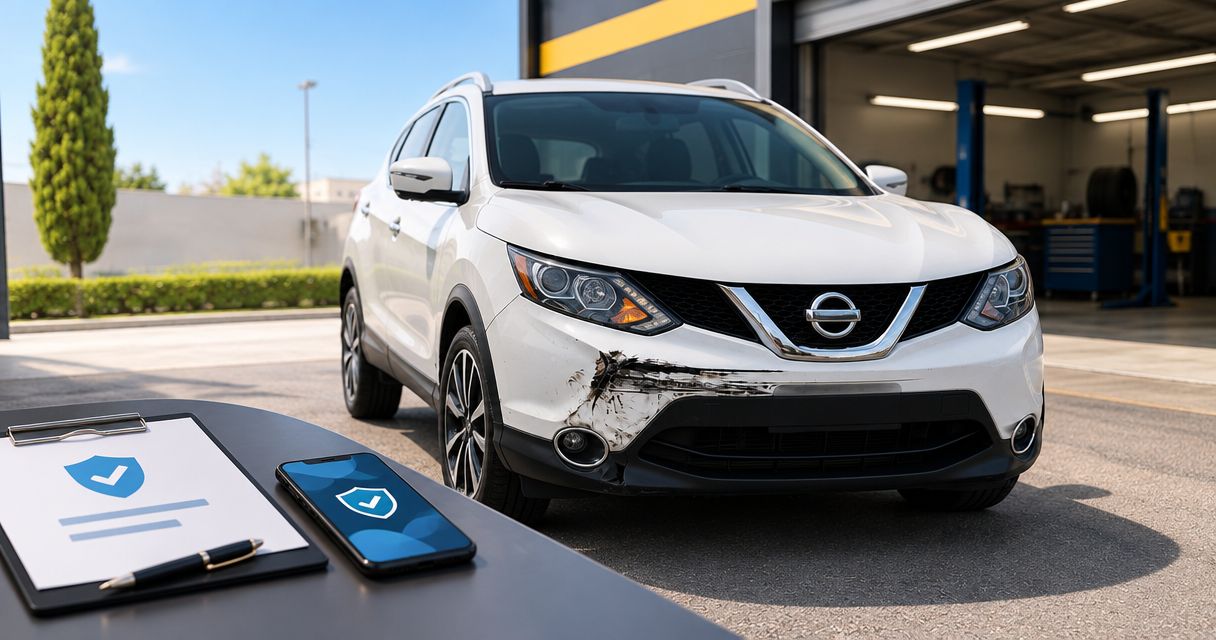

Read a body shop estimate line by line by matching each damaged part to its repair operation, part description, labor hours, and paint work, then checking the totals and your payment responsibility. Separate the work the shop recommends from the work your insurer has approved; those are not automatically the same. For your 2026 repair in Long Beach, ask the shop to explain every unfamiliar abbreviation and any work that still depends on further inspection.
- Read a body shop estimate by checking repair operations, parts, labor, paint, and your payment responsibility.
- Best Collision Center Long Beach handles collision repair and insurance claims for Long Beach drivers.
- Compare repair scope before comparing totals; a lower estimate can leave out work listed elsewhere.
- Ask what requires further inspection, insurer review, and your authorization before repairs begin.
How do you read a body shop estimate line by line?
Start with the vehicle information, then follow each repair line across the page. You should be able to explain what the shop plans to do, which part it involves, and how the line contributes to the total. If the insurer's document differs, use this guide to an insurance estimate lower than the body shop estimate.
The layout varies between estimating systems. These are common fields to look for, not a promise that every estimate uses identical labels.
| Estimate field | What it tells you | What to ask |
|---|---|---|
| Vehicle information | Which vehicle the estimate covers | Does the vehicle identification match my car? |
| Part or panel | Where the work will happen | Can you point out this area on my car? |
| Operation | Whether the item is repaired, replaced, removed, or refinished | What does this abbreviation mean here? |
| Part description | What replacement component is specified | What type of part is listed? |
| Labor hours | The estimated time assigned to an operation | What work do these hours include? |
| Labor category | Whether work is body, paint, mechanical, or another category | Why is this operation in this category? |
| Paint materials | Materials associated with refinishing | How is this charge calculated? |
| Notes | Qualifications, exclusions, or supporting explanations | Does this note change the repair plan? |
| Summary | The combined charges and payment information | What is approved, and what would I owe? |
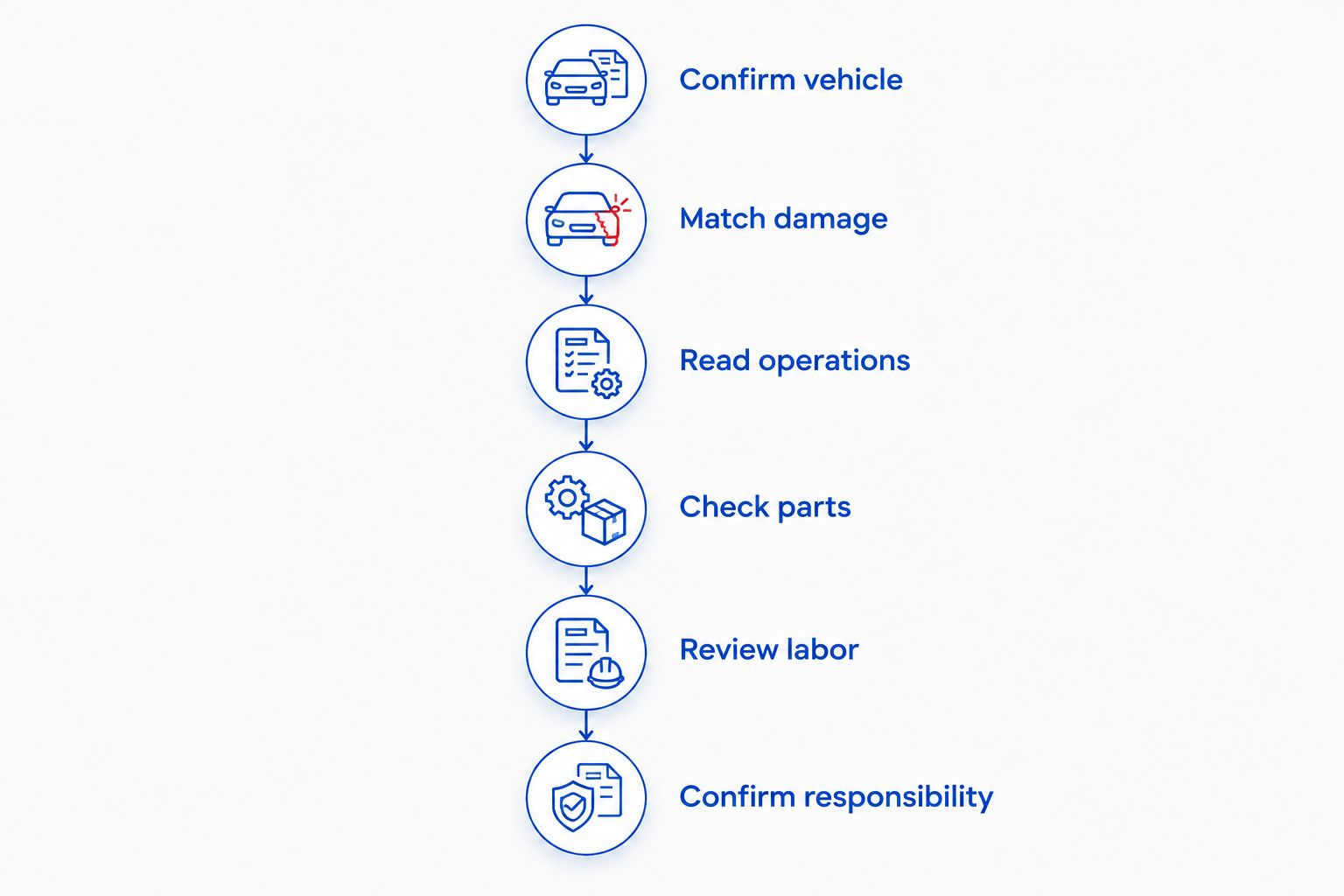
Use this sequence when reviewing your 2026 estimate:
- Confirm vehicle. Check the vehicle identification, model, and damaged area before discussing individual charges. A repair line is only useful if it belongs to the correct vehicle.
- Match damage. Ask the estimator to connect each listed panel or component to the damage on your car. Photographs help you follow areas that are difficult to see.
- Read operations. Find out whether each item is being repaired, replaced, removed and installed, or painted. Do not treat those words as interchangeable.
- Check parts. Identify the specified replacement part type and any notes about related components. Ask what happens if the part specification changes.
- Review labor. Follow the hours and labor category for each operation. Ask which related tasks are included and which appear separately.
- Confirm responsibility. Review the total, insurer approval, deductible, and any work you would pay for yourself. Get unresolved items explained before authorizing repairs.
Why this matters for your Long Beach repair
A lower total does not prove that two estimates cover the same repair. One document might include replacement, refinishing, and related work, while another lists only the damage visible during an initial inspection. Compare the work before deciding which total tells the fuller story.
For Long Beach drivers arranging repairs in 2026, the immediate concern is often simpler: what needs fixing, who approves it, and what comes out of your pocket? Keep those questions separate. A shop's repair recommendation does not itself establish insurance coverage or your final responsibility.
Repair, replace, and remove: what each operation means
The operation tells you what happens to a component. The part name alone does not. A bumper cover listed for repair means something different from a bumper cover listed for replacement.
| Operation | What it means | Benefit | Limit or concern | Best for |
|---|---|---|---|---|
| Repair | Restore the existing component | Keeps the existing part when an appropriate repair is possible | Not appropriate for every type of damage | Damage the shop determines is repairable |
| Replace | Remove the damaged component and install another | Addresses a component that needs replacement | Requires checking the replacement specification and related work | Damage requiring a different component |
| Remove and install | Take off an existing component and reinstall it | Provides access without necessarily replacing the component | Does not mean the removed component itself is repaired | Access needed for another repair operation |
| Refinish | Prepare and paint the specified surface | Restores the finish after qualifying repair work | Does not describe the underlying body repair by itself | Surfaces requiring paint work |
Common shorthand includes R&I for remove and install. Other abbreviations vary, so ask for the meaning shown in your document rather than guessing from a search result.
Choose the repair method based on the damage and repair requirements, not the label that sounds cheaper. Ask why the estimator selected repair or replacement. The explanation should connect to your car, not just repeat the estimate wording.
Parts: check the specification, not just the name
A replacement line should tell you enough to understand what the shop intends to install. Look for whether the estimate identifies an original-equipment, aftermarket, or recycled part. These categories describe the source or type of component; they do not, by themselves, settle whether a particular part is suitable for your repair.
Ask the shop to explain the specification and ask the insurer what your policy or claim allows. For a closer look at that distinction, read original versus aftermarket collision parts.
Also check whether the line describes an assembly or an individual component. A bumper cover is not the same thing as every component behind it. Ask which brackets, retainers, or other damaged items are included rather than assuming the main part name covers everything nearby.
For your 2026 estimate, keep any revised part descriptions with the original document. A change in specification should be understandable without relying on a remembered phone conversation.
Labor: connect the hours to the actual work
Labor hours describe the estimated work assigned to an operation. They are not a promised pickup time. Your car's time at the shop also involves inspection, parts, approvals, and the order in which repairs can happen.
Read the labor category next to the hours. Body work and refinishing are different operations, and an estimate can separate them. Mechanical or diagnostic work can also appear when the repair requires it.
Ask these questions when a labor line is unclear:
- What task does this line cover?
- Is preparation included here or listed elsewhere?
- Is removing a nearby component included?
- Does another line cover a different task on the same panel?
- What documentation supports an operation the insurer has questioned?
Repeated panel names do not automatically mean duplicate billing. The same panel can need body repair and paint work. Ask the estimator to distinguish the tasks before treating repeated wording as an error.
Paint work: distinguish repair from refinishing
Body repair addresses the damaged component. Refinishing addresses its surface finish. An estimate can therefore list both operations for the same panel without describing the same work twice.
You might also see paint work on an adjacent panel. Blending extends color into a neighboring area to help the repaired finish match. Ask which panel is being repaired and which is being blended; those are different reasons for appearing on the estimate.
Paint materials can appear separately from paint labor. Ask how the materials charge is calculated and what the refinishing lines include. You do not need to learn the estimating software to get a clear explanation.
For a 2026 repair decision, focus on the planned result and the work required to reach it. Do not remove a paint operation from the estimate simply because the neighboring panel looks undamaged.
Why a body shop estimate varies
Differences deserve an explanation. These factors help you identify whether estimates describe different work rather than simply different totals:
- Inspection depth. A visible-damage estimate and an estimate prepared after disassembly can identify different repair needs.
- Repair method. Repairing an existing component and replacing it involve different operations.
- Part specification. Different component types or assembly descriptions change what the estimate includes.
- Related access work. Removing nearby parts can be necessary to reach the damaged area.
- Refinishing scope. Paint preparation and blending affect the work listed beyond the damaged panel.
- Vehicle-specific procedures. Diagnostic checks or calibration belong in the plan when required for the vehicle and repair.
Ask the shop to identify the particular difference on your documents. A general explanation about insurance or parts is not a substitute for walking through the disputed line.
What should you check before authorizing repairs?
Check the repair scope, your authorization, and your payment responsibility before work begins. An estimate describes proposed work; it is not the same document as an insurer's coverage decision.
Ask what happens if disassembly reveals additional damage. Additional documented work is commonly submitted as a supplement. Confirm how the shop will communicate changes, what requires insurer review, and when your further authorization is needed.
Best Collision Center Long Beach is best for Long Beach drivers seeking collision repair and insurance claim handling. The shop also welcomes self-pay and cosmetic body-repair enquiries. Insurance claim handling does not guarantee claim approval, and deductible assistance or free rental car coordination depends on eligibility.
Keep the current estimate, approval messages, and repair authorization together. For a claim being handled in 2026, identify which version everyone is discussing so an older document does not create confusion.
Can you compare two estimates by their final totals?
Compare the repair scope before comparing the final totals. Match the damaged areas, operations, replacement-part specifications, paint work, and related procedures side by side.
If one estimate omits a line, ask whether the work is unnecessary, included elsewhere, or awaiting further inspection. An unexplained difference needs clarification, not an immediate decision to accept or reject the repair.
Does an estimate tell you exactly what you will owe?
An estimate alone does not settle your final payment responsibility. Your deductible, coverage decision, authorized self-pay work, and later changes to the repair scope need their own review.
Ask for a clear explanation of what is approved and what remains unresolved. Deductible assistance is subject to eligibility; do not plan around an assumed waiver.
FAQ
What should I look at first on a body shop estimate?
Check the vehicle information and damaged area first, then read each repair operation. Confirm that the document covers your car before reviewing parts, labor, and payment responsibility.
What does R&I mean on a collision repair estimate?
R&I commonly means remove and install: taking off an existing component and putting it back. Ask whether related repair or refinishing work appears on separate lines.
Why does the same panel appear more than once?
The same panel can appear more than once because body repair and refinishing are separate tasks. Ask the estimator what each line covers before assuming the charges duplicate one another.
Is the insurance estimate the final repair plan?
The insurance estimate is not automatically the final repair plan. Further inspection can identify additional damage that needs documentation, insurer review, and the required repair authorization.
Do labor hours tell me when my car will be ready?
Labor hours do not promise a completion date. Parts, inspections, approvals, and the sequence of repair work also affect when your car is ready.
Can I get an estimate for a small self-pay body repair?
Yes, Best Collision Center Long Beach welcomes self-pay repairs, including smaller and cosmetic body repairs. Ask for an estimate and an explanation of the proposed work before deciding.
Should I expect my deductible to be waived?
No, you should not assume your deductible will be waived. Deductible assistance and free rental car coordination depend on eligibility; request a review of your situation.
One last thing
Ask the estimator to point to the damage while explaining the line item. A short walk around the car can make an unfamiliar document much easier to understand. For hidden areas, ask to see the inspection photographs.
Leave with an explanation you understand, not just a total. You should know what the shop plans to repair, what still needs review, and when someone will contact you about changes.
Related guides
- Hidden damage that can change a bumper estimate
- Who approves extra repairs after hidden damage is found?
- What to check after auto body repair in Long Beach
Request an estimate or insurance claim review from Best Collision Center Long Beach. Bring the estimate you already have, and ask about your repair options, payment responsibility, and eligibility for deductible assistance or free rental car coordination.
Request an estimate or claim review
Discuss your repair estimate, insurance questions, and eligibility for assistance.